

.png)
The first that they picture a bright, shiny, brand-new, ultra-modern building — the kind that sits in the top 1% of commercial real estate.
In fact, these buildings are often surprisingly unsmart. One of the most expensive buildings ever built in APAC had more than 50 systems, and none of them were connected. Buildings like this may look impressive, but by definition they are not smart — and often not particularly green either, despite the badges and awards they might sport.
Many of the buildings that Switch hosts on our platform are small, modest and not very sexy. But they are smart. Why? Because the systems within those buildings are connected and can exchange information, and the data from those systems is collected and understood in one place.
A smart building is a building that uses connected systems and operational data to continuously understand how the building is being used, how it is operating, and how it is impacting the comfort of tenants and occupants. The smartest buildings use that intelligence to continuously improve performance through human intervention, automated actions, or both.
The second misconception and one of the biggest is that a modern Building Management System (BMS) makes a building smart.
Owners and operators who have been wined and dined by the big equipment companies and signed up for multi-year deals like to imagine they have the most modern technology in their buildings. And they may well have. But a modern BMS is only one part of what makes a building smart.
The BMS typically controls the plant and equipment responsible for heating and cooling, and often lighting and metering. But what about all the other systems that support the people who use the building — indoor air quality, occupancy sensors, meeting room bookings, visitor registration, people counting, access control, security turnstiles, vertical transportation, blinds and awnings? The list is almost endless.
Many of these systems operate independently of the BMS and independently of each other. If the systems within a building cannot connect, exchange data and provide a shared understanding of how the building is operating and being used, then having a sophisticated BMS does not, by itself, make it a smart building.
And this brings me to the third and fourth misconceptions: that a smart building solution requires a BMS, or that it replaces the BMS. Neither is true.
In large commercial or corporate buildings with an existing BMS, a smart building solution will typically connect to and interact with the BMS. In smaller retail sites or Class B/C buildings, however, there may be no BMS at all. These buildings often operate with standalone systems such as smart thermostats and manual lighting controls.
In these cases, a smart building platform can connect these standalone systems and provide many of the monitoring, analytics and control capabilities required to operate the building intelligently — without the cost or complexity of installing a traditional BMS.
And the final misconception we frequently encounter when building owners and operators begin their digital journey is that becoming a smart building requires major equipment upgrades — or worse, ripping out perfectly good systems and starting again.
Most of the buildings we encounter are already built and already have systems deployed. Owners and operators typically have a myriad of manufacturers across their portfolios, using different networking and equipment protocols. No two buildings are the same, and digitizing the portfolio has to compete with every other demand for capital.
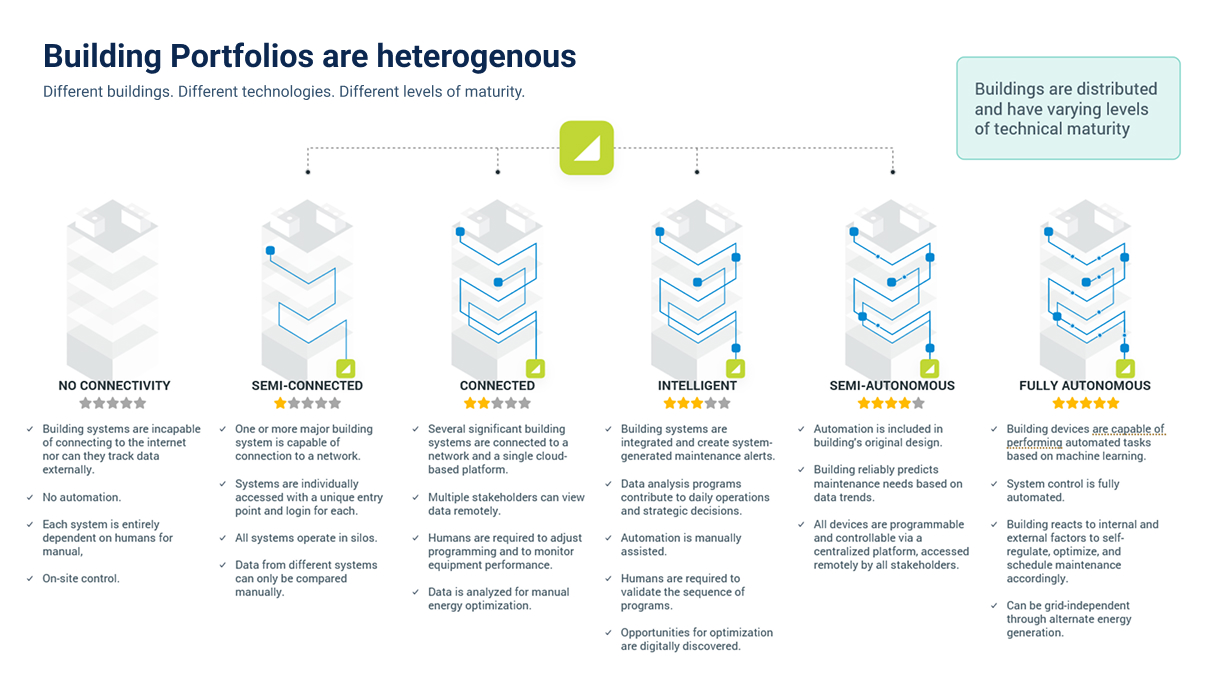
They are looking for solutions that will allow them to harness the data from those systems, improve the operability of the building, reduce maintenance costs and enhance the environment for the building occupants.
All commercial buildings — whether office, retail, education, healthcare, transportation or something else — ultimately have the same mission: to provide space that is fit for purpose, maximize the value of that space and operate it at the lowest practical cost. A smart building solution should help you do exactly that.
So, what actually makes a building smart?
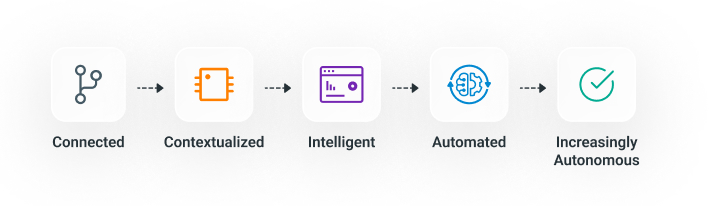
Connected — The systems within the building are connected so their operational data can be securely collected and exchanged. Traditional building systems may connect through a converged building network and secure edge infrastructure, while cloud-enabled IoT systems may exchange data through APIs or their own cloud environments.
Contextualized – Every manufacturer, systems integrator and commissioning professional has their own naming conventions, methods and standards. Across a large portfolio, that can result in thousands — or millions — of data points with little consistency from one building to another. Local naming remains important to the people who maintain those systems, so a smart building platform needs to add a common contextual layer without removing useful local information.
Intelligence – Once systems are connected and a building ontology provides context to the data, analytics can begin to identify faults, patterns, trends and opportunities. Instead of simply collecting data, the building can now tell operators what is happening, what is abnormal and where attention is required.
Automated – Intelligence becomes more valuable when it can drive action. Automation can range from creating an alert or work order when a problem is detected to bi-directional control that changes how equipment operates. The outcome of that action is then measured, closing the loop between insight, action and performance.
Increasingly autonomous – The most advanced smart buildings are beginning to move beyond predefined automation. They can continuously measure equipment and building performance and adjust operations in response to changing conditions such as weather, occupancy, equipment drift and energy demand. Human oversight and operational guardrails remain critical, but increasingly the building can identify, act, measure and adapt without requiring an operator to initiate every step.
Summary
TL:DR
- A smart building does not need to be new, expensive or filled with the latest technology.
- A modern BMS alone does not make a building smart — and a smart building platform does not necessarily require or replace a BMS.
- Existing building systems and equipment can usually form the starting point. Becoming smart should not require a wholesale rip-and-replace program.
- Smart buildings connect previously isolated systems, add context to their data and use that intelligence to improve how the building operates.
- Smart building maturity progresses from Connected → Contextualized → Intelligent → Automated → Increasingly Autonomous.
- The objective isn't technology for technology's sake. It's a building that better serves its occupants while improving performance and reducing operating costs.


