

.png)
Traditional Facilities Management – background
Facilities Management (FM) is the day-to-day management of buildings, their systems and the services required to keep them safe, functional, comfortable and efficient. It encompasses everything from cleaning and security to equipment maintenance, compliance, energy management and workplace services.
Some property owners take care of FM themselves and in many geographies, there are thousands of small, family-owned businesses that service local markets. And just like accounting and consulting, there are a cluster of very large multinational facility management companies, such as CBRE, JLL, Cushman and Wakefield, Colliers and ISS that operate global contracts with the world’s biggest companies.
What does FM do?
Facility management tasks are generally split into hard services and soft services.
- Hard Services: cover the physical, structural, and mechanical systems like plumbing, electrical work, elevators, and heating, ventilation, and air conditioning (HVAC). Many of these services were enlisted during building construction and remain in contract past handover.
- Soft Services: People-oriented tasks that improve comfort and usability, such as cleaning, catering, security, landscaping, and waste management.
A lot of the traditional FM industry runs on a high-volume, low-margin model and many FM contracts are competitively tendered and delivered against tightly controlled budgets with intense competitive bidding, meaning small operational errors or rising labor costs can quickly erase profits.
Why FM needs to change
The FM industry is facing a combination of challenges that are increasing the structural pressure on FM economics:
Labor intensity + rising wages + skills shortages + fixed-price contracts + increasing client expectations + more complex buildings + sustainability requirements + more reporting + limited differentiation.
Most of the well-known FM companies support huge workforces and operate on low margins. Historically they had other parts of their business that benefited from the long-term relationship with property owners.
Along with the increasing economic pressures on the industry there is a rising exposure to risk and higher compliance and reporting requirements.
Customers increasingly expect FM teams to do more, while simultaneously expecting them to do it with fewer people and lower operating costs.
Another challenge is differentiation. Traditional FM services are highly dependent on people, and those people frequently move between service providers as contracts change hands or better opportunities arise. This makes it difficult for FM companies to create sustainable differentiation based solely on their workforce.
When customers perceive relatively little difference between competing service models, price inevitably becomes a major bargaining lever. Providers then face pressure to deliver contracts with fewer people, less experienced people, or less time allocated to each building.
Digital FM provides another way to compete — through better information, greater productivity, more consistent service delivery and measurable outcomes rather than simply lower labor cost.
Emergence of PropTech
Concurrently, a new technology ecosystem has emerged around commercial real estate. PropTech companies now provide specialist technologies for energy management, workplace experience, occupancy, building analytics, IoT, maintenance, sustainability and smart building operations — capabilities that historically sat within, or adjacent to, the FM service model.
Most of the big service providers recognized the emerging PropTech trend and responded with acquisitions or internal builds, with mixed success. Technology innovation requires a mix of software engineering, product management, data science, cloud infrastructure and continuous R&D, disciplines very different from managing a labor-intensive service business. The operating model that made large FM companies successful wasn't designed to build and continuously evolve software products.
The case for digital
Why the traditional operating model struggles.
Traditional FM models often rely on identifying issues during scheduled maintenance inspections or waiting for something to be reported by a human in the building. Both of these are problematic: either relying on the skills, diligence and patience of your maintenance technician or waiting for occupants to be so inconvenienced they will go out of their way to log a ticket.
Is it any wonder buildings can have unresolved issues that can last years and cost thousands of dollars?
There is also a compelling economic case for digital.
FM companies spend millions of dollars putting technicians into trucks and vans to drive to buildings to inspect equipment when the data to identify those problems is already at hand.
The data should be powerful enough to identify the problem, analyze the root-cause, often remotely triage the issue, and if a truck roll is required, the technician is dispatched knowing the issue they are resolving, where in the building it is and with the correct parts on hand.
Digital FM doesn't eliminate the truck roll when physical work is required. It makes sure there is a good reason for the truck to roll in the first place.
Owners and operators may not know which buildings are performing poorly until a complaint, failure, invoice or periodic report reveals it, making budgeting and financial planning a challenge.
Taken together, increasing economic pressure, rising risk, greater compliance requirements and the limitations of traditional reactive FM create a compelling case for digitizing the industry.
What is Digital Facilities Management?
Digital Facilities Management is the use of connected building data, analytics, digital workflows and automation to change how facilities services are delivered — moving FM from manual, scheduled and reactive processes toward data-driven, predictive and increasingly automated operations.
The evolution of Facilities Management
From manual and reactive to data-driven, predictive and automated.

Manual
People and paper processes, Reactive and site-based.

Digital
Core processes moved to digital tools (e.g. CMMS). Same processes, greater efficiency.

Data-Driven
Connected building data provides visibility and insight across systems and sites.

Predictive
Analytics and AI identify issues before they impact occupants. Maintenance is triggered by condition, not the calendar.

Automated
Integrared systems orchestrate actions across buildings and portfolios. More automated and self-optimizing operations.
Digital FM is a progression rather than a single technology implementation. Organizations typically move from manual and reactive processes, through digitization and data-driven operations, toward predictive and increasingly automated service delivery. Not every FM process needs to reach the final stage, but each step reduces reliance on manual information gathering and improves the quality and speed of operational decision-making.
For more on the underlying technology layer, see What Is a Smart Building Platform?
Digitizing FM is not the same as Digital FM.
Digitization changes the medium. Digital FM changes the operating model.
Moving a paper maintenance form into a CMMS is digitization.
Having equipment automatically identify abnormal performance, create a work order, provide the technician with diagnostic information, verify that the repair resolved the problem and record the outcome is Digital FM.
What does Digital FM look like in practice?
| Traditional | Digital |
|---|---|
| Technician is dispatched to investigate a reported equipment problem. | Building data is analyzed remotely to diagnose the likely cause before a technician is dispatched. |
| Compliance records are assembled manually from contractors, spreadsheets and reports. | Compliance activities and evidence are captured through digital workflows and available continuously for review. |
| Technician performs monthly equipment inspection. | Equipment performance is continuously monitored and maintenance is triggered by condition. |
| Cleaner follows a fixed schedule. | Occupancy data identifies which spaces have actually been used and cleaning is dispatched accordingly. |
| Engineer discovers an HVAC problem after a comfort complaint. | FDD identifies degrading performance before occupants notice. |
| Energy team reconciles spreadsheets quarterly. | Energy and sustainability data is continuously collected, normalized and compared against targets. |
| Public holiday schedules are changed building by building. | Schedule changes are deployed centrally across the portfolio. |
Advantages of Digital FM
- Increase productivity: Allow the same FM team to manage more buildings and equipment.
- Move from reactive to proactive: Find problems before occupants do.
- Reduce unnecessary site visits: Remote visibility and diagnostics help determine when physical intervention is actually required.
- Improve maintenance: Move toward condition-based and predictive maintenance.
- Standardize service delivery: Apply common workflows, analytics and operating practices across portfolios.
- Improve contractor accountability: Measure whether work actually resolved the issue.
- Reduce energy and operating costs: Identify waste and automate corrective actions.
- Improve reporting: Automate collection of operational, energy and sustainability information.
- Improve occupant outcomes: Connect building performance with occupancy, comfort and IAQ.
- Protect FM margins: Digital FM gives service providers the opportunity to improve service quality without increasing labor at the same rate.
Does Digital FM replace facility managers?
No — but it changes the work.
In a digitally enabled operating model, FM professionals spend less time gathering information, manually checking equipment and responding to avoidable problems, and more time:
- making decisions;
- managing exceptions;
- optimizing performance;
- coordinating specialists;
- improving occupant outcomes;
- managing risk;
- planning capital expenditure.
Where does AI fit in Digital FM?
AI accelerates the transition from data, diagnosis and recommendation into action, but it depends on trusted and contextualized building data.
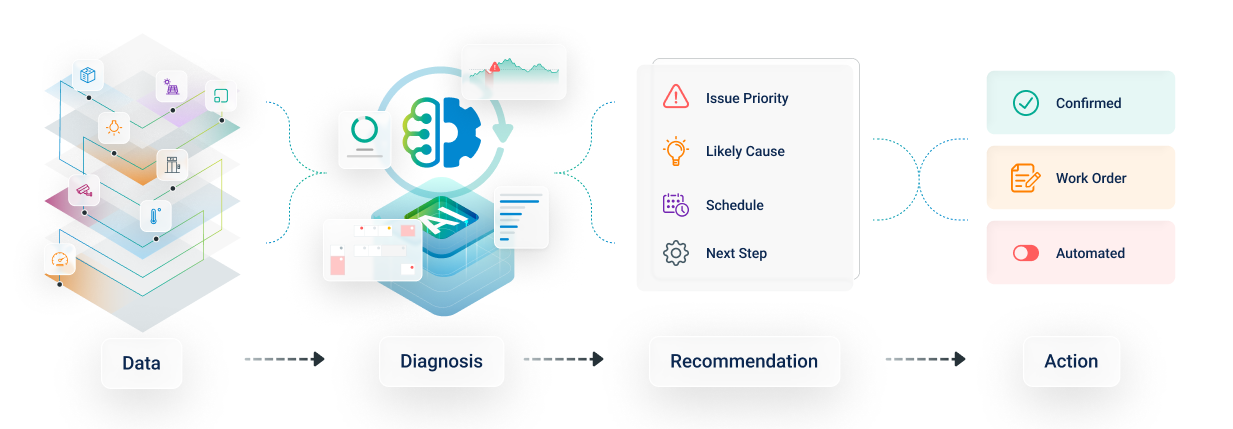
We explore why this data foundation matters in What Is a Smart Building?
AI can help FM teams investigate faults, summarize large volumes of operational information, prioritize competing issues, recommend actions and automate routine workflows. Over time, it will also support increasingly autonomous building operations.
But AI is only as useful as the information available to it. Without connected systems, trustworthy data and sufficient context about the building and its equipment, AI has very little reliable information on which to act.
Summary
Digital FM gives service providers the opportunity to improve service quality without increasing labor at the same rate. For an industry facing rising wages, skills shortages and pressure on contract pricing, that may ultimately be the most important benefit of Digital FM.
Digital FM isn't about replacing facility managers with technology. It's about giving FM teams the data, intelligence and automation to manage more buildings, more effectively, with fewer manual processes.


