Artificial intelligence is rapidly finding its way into building technology. Almost every software platform now has an AI story, and increasingly that story starts with a chatbot.
Ask a question about your building. Get an answer. Ask another question. Get another answer. It's an impressive demonstration of what AI can do. But it’s not what building owners and operators really need.
At Switch Automation, we've spent considerable time experimenting with AI, talking to customers, and considering how these technologies can genuinely improve the operation of large building portfolios.
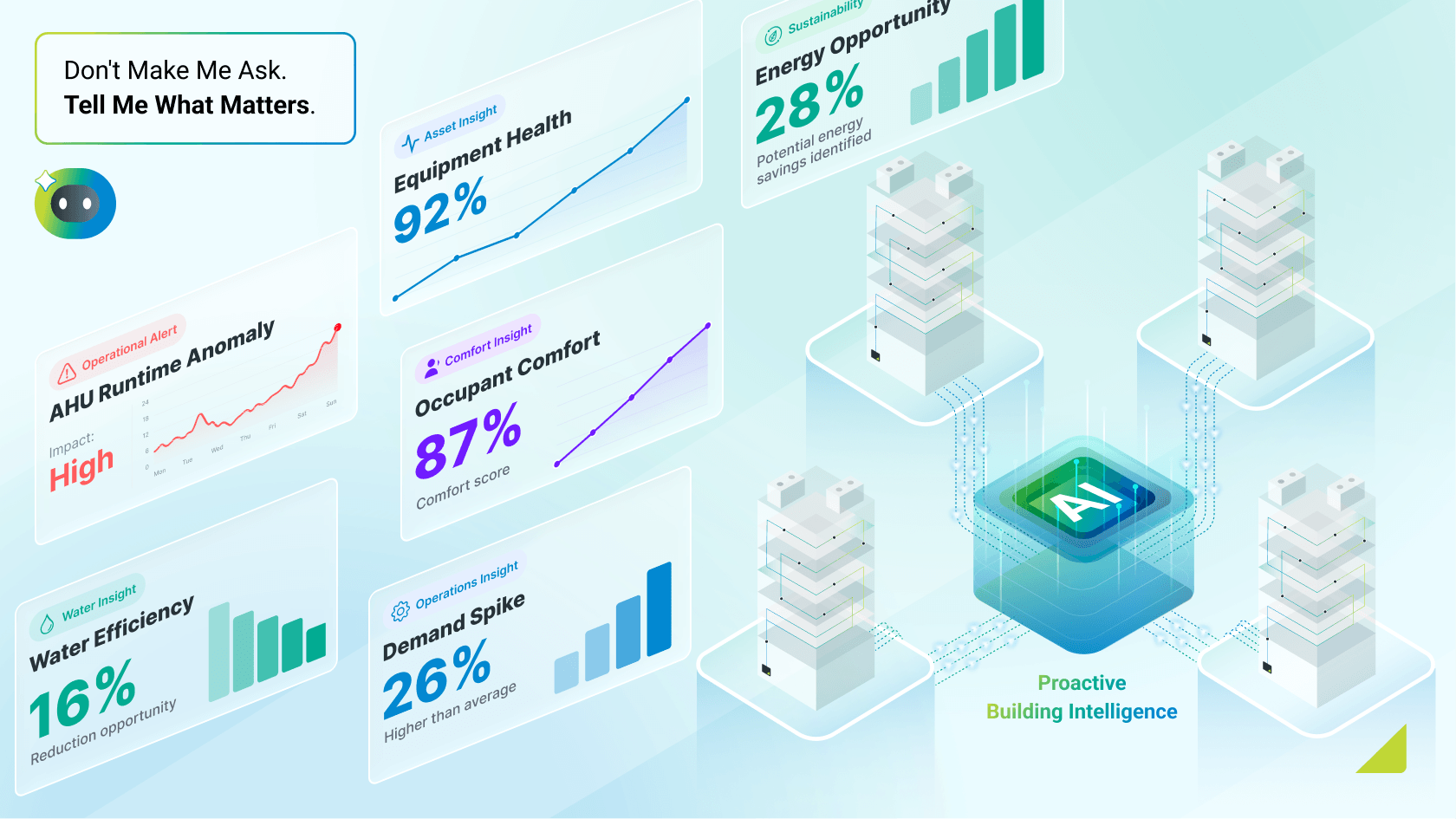
One message has come through clearly: our customers don't want another system they have to interrogate. They want their technology to tell them what matters.
That insight has fundamentally shaped our AI strategy.
The Problem Isn't a Lack of Information
Modern buildings generate enormous volumes of data. Across a large portfolio, that can mean millions of data points collected from HVAC systems, meters, sensors, lighting, building management systems and other connected technologies.
The challenge isn't simply collecting that information. It's determining what is important, understanding its operational significance and deciding what to do about it.
Consider a facilities manager responsible for hundreds of buildings. They don't have time to examine every alarm, compare every equipment trend or investigate every abnormal operating condition. Even with sophisticated dashboards and analytics, there is still a substantial burden on people to discover problems, establish priorities and coordinate action.
Adding a chatbot doesn't necessarily remove that burden. Instead of navigating dashboards, the user now has to work out which questions to ask.
The opportunity for AI is to reverse that relationship.
Rather than waiting for a question, we believe the platform should continuously evaluate building performance, identify meaningful issues and opportunities, and bring relevant intelligence to the people responsible for acting on it.
Conversational AI still has an important role. But it becomes a way to investigate, clarify and act on information the platform has already identified—not the primary mechanism for discovering that information.
From Technical Alerts to Business Value
For building owners and senior executives, the questions are rarely about individual sensors or equipment alarms.
They want to know:
- Are our operational teams working efficiently?
- Where are the greatest opportunities to reduce costs and energy consumption?
- Can we make better capital investment decisions based on actual equipment condition and performance?
These are business questions, not simply engineering questions.
Traditional building systems are good at reporting technical conditions. A chiller is operating outside its expected range. An air handling unit is running after hours. A sensor has stopped reporting. But the business significance of those conditions isn't always obvious.
This is why Switch has been investing in analytics that categorize operational issues across areas such as energy, comfort and maintenance, and associate findings with estimated financial and energy impacts.
The objective is to help customers prioritize work based on operational and business value rather than simply the volume of alarms.
Building the Foundations Before Adding Intelligence
AI is only as useful as the information and context available to it. A language model might be very good at explaining what an air handling unit does. That doesn't mean it understands how a particular unit is configured, what equipment it serves, how it has performed over the past month or whether its operating schedule is appropriate.
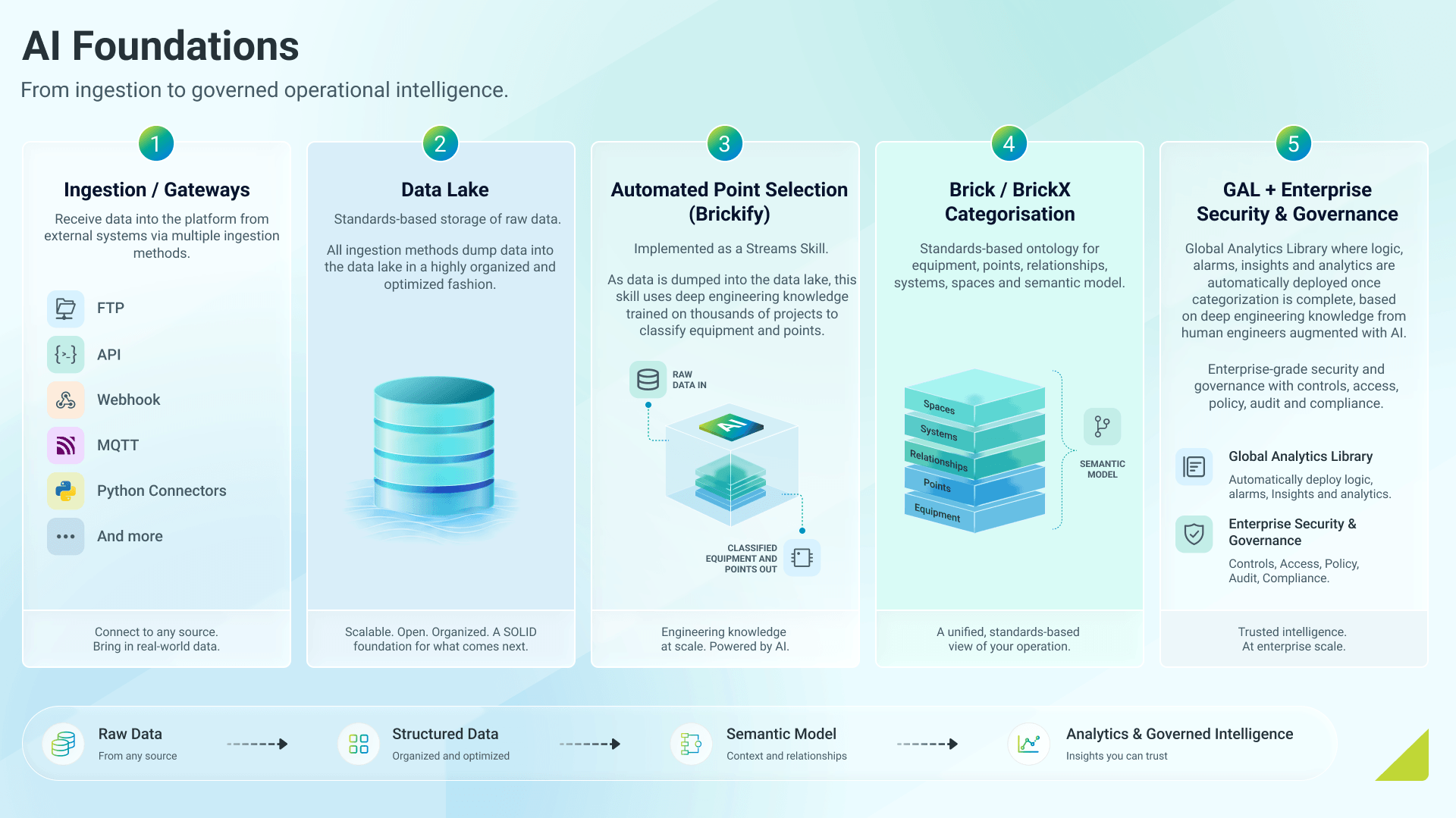
That knowledge has to come from the building's actual operational data and for Switch, this has meant investing in three foundational capabilities.
1. Automated Point Selection for data ingestion and contextualization.
Building data is notoriously inconsistent. Naming conventions, equipment configurations, point structures and integration protocols vary significantly between buildings and vendors.
Switch uses AI-Assisted Semantic Modeling to automate data ingestion and mapping and to apply ontology-based modelling. This process organizes the information into a consistent building data foundation, creating the necessary context to understand relationships between buildings, equipment, sensors and operating conditions.
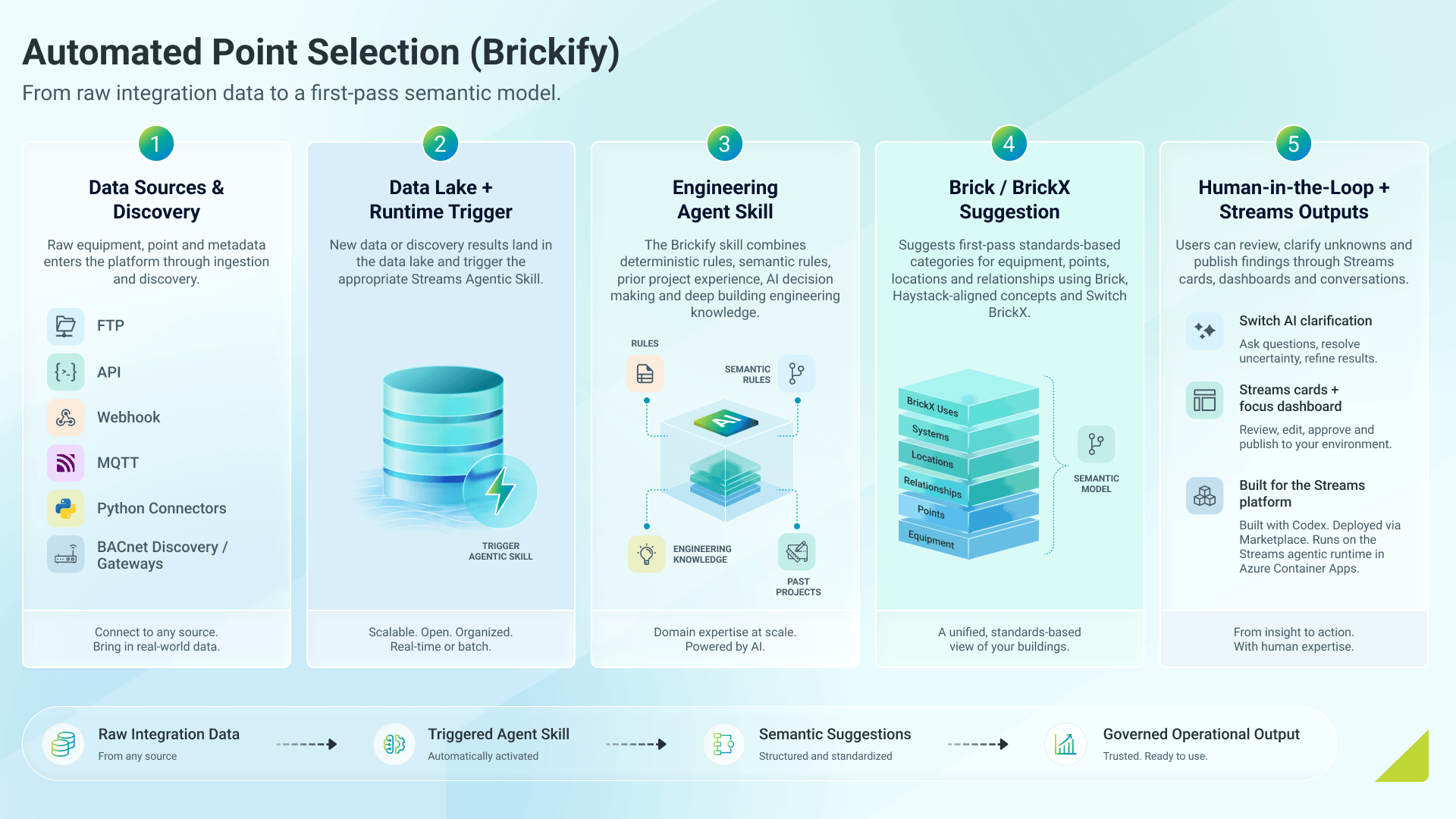
2. Automated Analytics: a global analytic library that can be applied consistently at scale.
Historically, building analytics have often required considerable manual configuration and the effectiveness of a deployment could depend on which rules were enabled, how they were configured and the expertise available to maintain them. Our objective is to automate the application of relevant analytics to provide consistency and time to value.
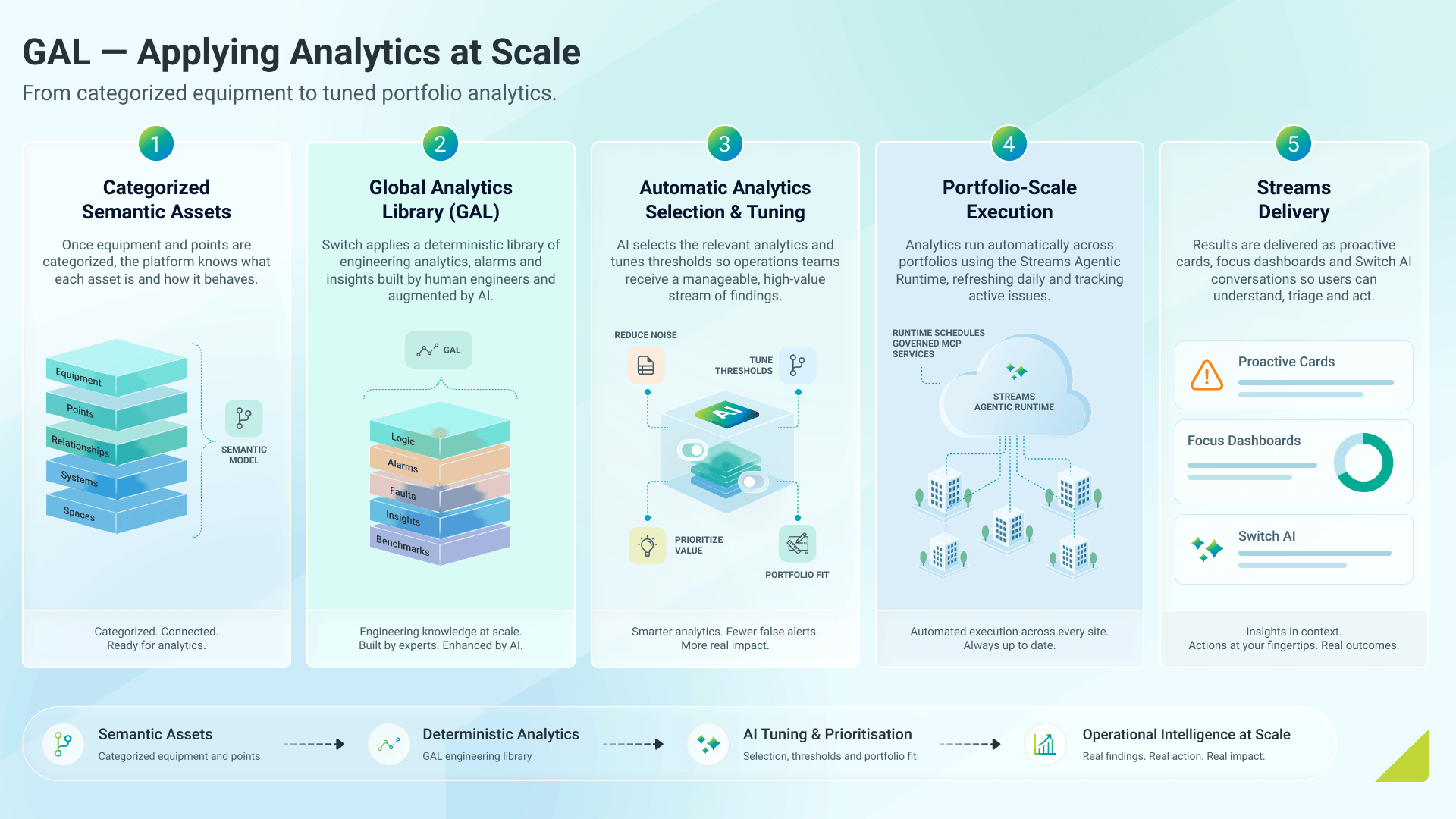
3. AI Insights: translating technical findings into business opportunities.
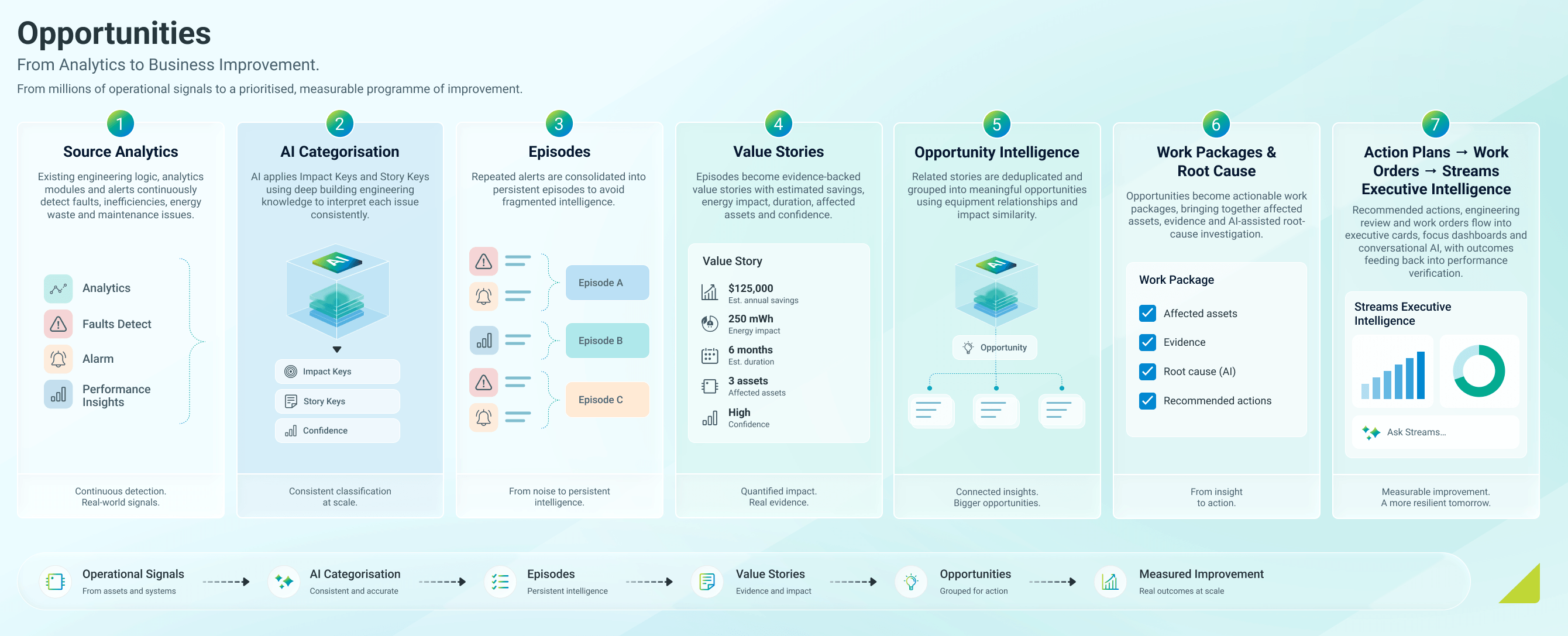
Identifying an operational problem is useful. Understanding its potential financial, energy or operational impact makes it actionable. We have developed a model to estimate the financial and energy impacts of opportunities identified through our analytics, helping customers prioritize interventions based on potential value.
Turning Engineering Expertise Into Reusable Intelligence
One of the most promising applications of AI is its ability to help capture and scale engineering expertise. Experienced building engineers know how to investigate complex problems and how to distinguish a genuine fault from normal equipment behavior.
Switch is developing an approach in which engineering investigation methods can be captured as reusable AI-assisted Skills for deployment across different portfolios, sites and equipment groups.
The important principle is that we don't need to reinvent the investigation every time the same type of problem occurs in another building. A repeatable engineering method can be applied consistently via the AI Skill with interpretation, investigation and recommendations where appropriate.
This is not about replacing engineers. It's about allowing a relatively small number of experienced engineers to extend their expertise across much larger portfolios, reducing repetitive analysis and leaving more time for complex problems that genuinely require human judgment.
Introducing Switch Streams: Intelligence That Comes to You
The most visible expression of our AI strategy is Switch Streams.
.png)
Streams is being developed as a new way for customers to interact with operational intelligence across their building portfolios. Rather than requiring users to navigate multiple dashboards, reports and alarm lists, Streams is designed to deliver a personalized feed of findings, opportunities and recommended actions.
The experience is familiar: content organized into cards, channels and focused views, with the ability to follow areas of interest, investigate individual findings and collaborate with colleagues. But unlike a social media feed, the objective isn't to maximize engagement.
It's to reduce operational noise and direct attention toward the issues that matter most.
A portfolio executive might see significant financial opportunities, recurring performance issues and portfolio-wide trends. A facilities manager might see equipment problems, unresolved operational tasks and recommendations requiring attention. An energy manager might see abnormal consumption, demand peaks or opportunities to improve operating schedules. A building engineer might receive more detailed diagnostic findings, supporting evidence and investigation results.
The underlying information may be shared, but its relevance and presentation should reflect the user's responsibilities. Over time, we intend for Streams to become increasingly personalized, learning from user interests, responsibilities and interactions while ensuring that important operational issues are not overlooked.
Each significant finding should help answer a few fundamental questions:
What happened?
Why does it matter?
What evidence supports it?
What is the potential impact?
What should happen next?
And ultimately: Did we resolve the problem?
Finding the Problem Is Only Half the Job
Smart building platforms have become increasingly capable of identifying problems. But finding a fault doesn't fix it. This is where we see the next significant opportunity for AI.
Our long-term objective is to connect intelligence more directly to operational workflows. That includes remote investigation, prioritization, work planning, approved control changes and post-intervention verification. The progression is straightforward:
Detect → Investigate → Recommend → Approve → Execute → Verify.
The real value is not simply that AI can recommend an action. It's that the platform can support a governed process for completing that action and evaluating the result.
Autonomous Investigation Is Not Autonomous Control
The idea of autonomous building operations is attracting considerable attention. But there is an important distinction between allowing AI to investigate a problem independently and allowing it to make changes to physical building systems.
Our governing principle is:
AI understands, interprets and proposes. Switch authorizes, validates and executes. The Agent then verifies.
AI agents can be designed to investigate approved data and develop recommendations within defined scopes, but operational authority remains with governed Switch services, established permissions, approval policies and audit mechanisms.
The AI model itself is not the building control system. This separation is fundamental to building customer trust and supporting responsible adoption of increasingly advanced automation capabilities.
Our customers operate complex, often highly regulated property portfolios. They rightly expect detailed answers about data security, privacy, access control and the use of AI models. Those expectations are shaping our architecture.
Our approach emphasizes authorized access to customer information, defined agent permissions, controlled use of operational evidence, traceable recommendations and human oversight of material actions. We recognize the importance of distinguishing between using AI to deliver a service and allowing customer data to be used for model training.
Switch's intended commercial approach is to offer AI capabilities as an optional addition to its existing SaaS platform, with customer control over adoption. Customer data will not be used for model training without separate permission. Just as importantly, we are designing for explainability.
Trust cannot be established through confident-sounding AI responses. It has to be supported by architecture, governance and operational evidence.
Measuring Success by Outcomes, Not Conversations
There is a temptation to measure AI adoption through the number of conversations, prompts or generated responses. Those metrics tell us very little about whether a building portfolio is operating more effectively.
We believe more meaningful measures include how quickly important issues are identified and prioritized, and how the financial and energy value is verified and conveyed to the program stakeholders. These measures connect AI investment to operational outcomes.
The Road Ahead
We intend to continue working closely with participating customers to test the experience, validate the usefulness of recommendations and understand where AI can deliver the greatest operational value, expanding the library of engineering skills, and developing more sophisticated agent capabilities.
From building data to building intelligence. From analytics to autonomous operations.
That's the direction we're taking at Switch.
And we want our customers to help shape it!